Wednesday, 10 October 2012

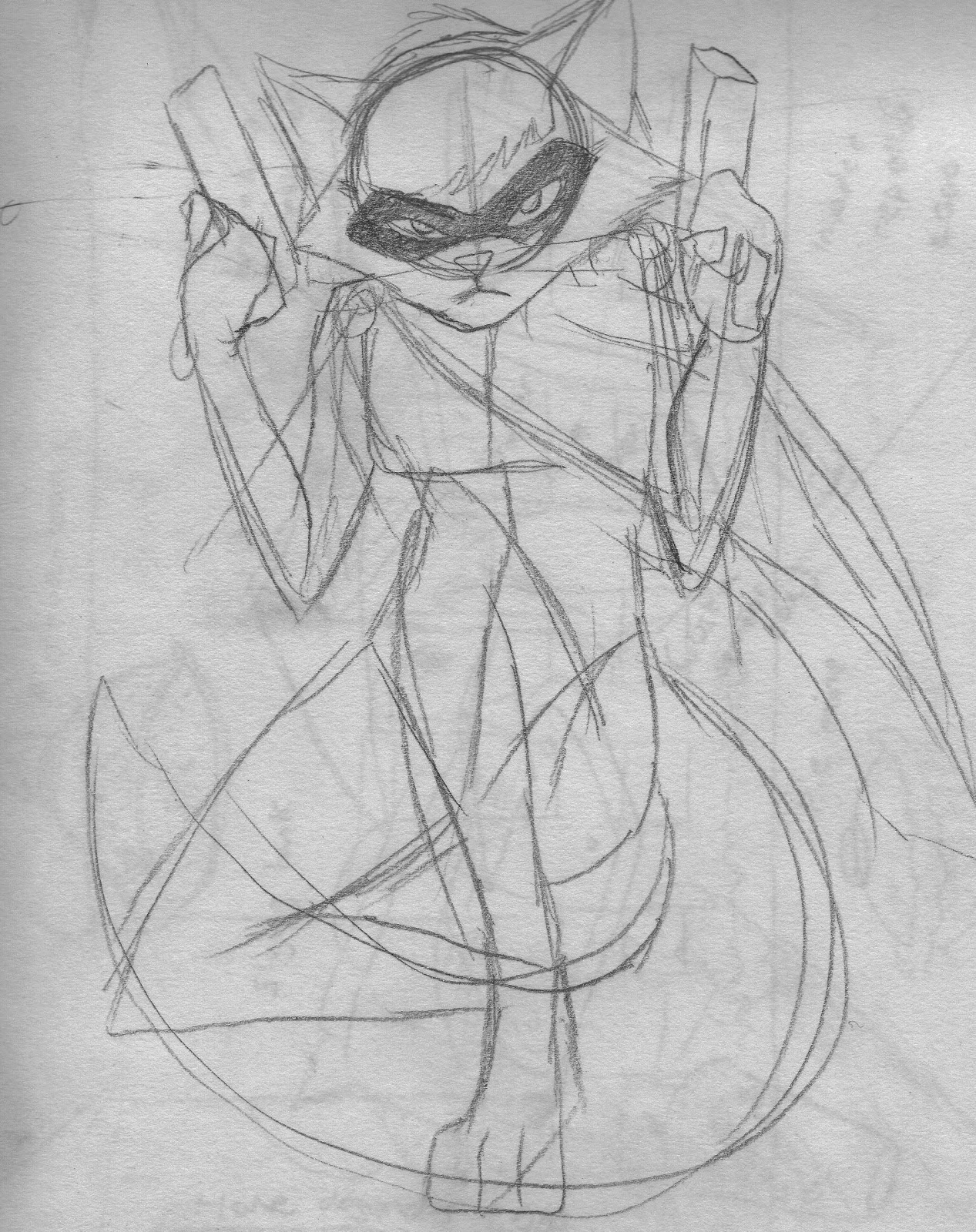
Character: Base Storyline/Premise and initial character concepts.

Basic Story:

Under the tyrannical and corrupt rule of a government lead by a vicious and greedy corporate criminal mastermind known only as the 'Fat Cat', the city of Jennisburg suffers in silence. However, after attempting to bring his daughter, Kat Hearth, into the family business to organize crime by his side, Fat Cat is shocked after she outright refuses after witnessing the horrors and atrocities he commits. 

Fearing for the safety of his corporate empire, he attempts to rid himself of her by having his bodyguards throw her into a vat of chemicals at a nearby science lab. Thinking her dead, they leave her body to corrode in chemicals. Fat Cat promotes one of his bodyguards, Thane 'Snapjaw' Seth, to be his right hand man and serve as his representative out in the city while the mastermind hides in shadow in his headquarters plotting the next move. Unbeknownst to them, Kat had survived the chemical dip, gaining superhuman senses, heightened agility and immortality. 

As her father controls the city, she is forced to keep the facade of her death and dons the identity and new life of The Black Panther, seeking to ruin her father's corporate empire, restoring Jennisburg to a fair democracy and erasing his existence from the city.


Kat Hearth/The Black Panther

 Fat Cat

Thane 'Snapjaws' Seth


(Any feedback would be appreciated!)

Tuesday, 9 October 2012

Character: examples of the 'Animal Superhero' genre

Example 1: Danger Mouse

As the name of the series suggests, 'Danger Mouse' has the main hero being portrayed as a mouse. The genre itself is more of a mixture between an action, secret agent and superhero. Danger Mouse doesn't exactly have any superpowers himself and relies on defeating his foes through wit and technology. He also has a mole as a sidekick named 'Penfold' who adds plenty of comedy relief to the series. Overall, Danger Mouse has the kid-friendly, Saturday-morning-cartoon feel to it.


Example 2: Darkwing Duck
Darkwing Duck was aired as a TV series during the 90s by Disney. Again, the main hero is of the same species as the title suggest. The series, and especially the hero, parodied many tropes as seen by the stereotypical superhero, giving the whole show a comedic background. The hero is bad-tempered, short-sighted and clumsy, but the plot usually came around with him coming through showing the viewers his true power. His sidekick is Launchpad McQuack from the Duck Tales series, broadly-built, but dim-witted.


Example 3:  Dynomutt
Dynomutt combines three different genres including the two that are already obvious: robotic, anthropomorphic, superhero. Dynomutt has robotic powers, but uses them ineffectively due to his clumsiness. However, he is somewhat of a sidekick due to his human super-hero master, even though the show is primarily about his pet. He and his master fight crime in the aptly named city of 'Big City'. The series once again goes down the route of comedy.


Example 4: Earthworm Jim
Originally based on the side-scrolling video game of the same name, Earthworm Jim is just as weird as its video game predecessor and is rife with post-modernity. Earthworm Jim was once an everyday garden worm until a special space suit fell from space. The worm crawled inside of it, turning it and the suit into a rather bizarre superhero mix of the two. The series blends sci-fi with the superhero genre; Earthworm Jim, throughout the series, has plenty of space-based adventure with his small puppy sidekick, Peter Puppy.


Example 5: Looatics Unleashed
A controversial series among fans of the original Loony Tunes, Loonatics Unleashed took place in a sci-fi, dark techno-punk universe with an equally dark and gritty cast of super-powered versions of the original Loony-Tunes. In 2772 the planet-city of Achmetropolis is struck by a meteor, causing all of the future Loony Tunes to gain super-powered abilities. The series was met with a strong reaction by Loony Tunes fans because they saw it as messing with the source material and a poor attempt to pander to the teenage demographic. The series attempted to take on a darker approach than most other cartoon shows attempting the merging of these two genres.

Example 6: Road Rovers

This aired from 1996 until 1997; a relatively short lived Saturday morning cartoon show. The Road Rovers are a gathering of regular canines who eventually turn into anthropomorphic superheroes, using their gadgets and powers to defeat criminals and stomp out crime. They can temporarily turn into these super-powered anthropomorphic beings to fight crime, but their alter-egos are loving, household pets. The show was another lighthearted take on these two genres.


Overall, what most of these shows have in common are that many of them are child-friendly and lighthearted to appeal to a younger demographic. In order to try and do something different, I have decided to attempt a darker tone and try to design my characters and story so that audiences can take them seriously.

Narrative: 'useless invention' ideas and initial backdrop concept.


Backdrop idea #1


What each device could do:

Home Defender 2000: A large rocket for use in the home. Funny due to the fact that explosive firearms are readily available for everyday use in the American home in this universe.

Flying Tank: Self explanatory. Small, comedically ineffective wings.

Alert-a-thon: Supposedly alerts the wearer of people breaching the american border. Funny due to the fact it is a colander with a siren stuck to the top.

Commie-b-gone spray: Sprays the wearer with the 'scent of democracy' to supposedly scare away communists.

Pie mine: Deliver to your next door neighbor should you suspect them being aliens or communists as a friendly 'gift'

Brainwave reflector: Supposedly block radio waves from aliens that control your mind.

Portable shelter in a box: A large, cement box to jump into lest a bomb explodes. Completely impractical as a portable device. Large and heavy.

Invader repeller 2000: 'Repel' the invaders of freedom and democracy with this top-of-the-notch invention! Funny due to the simplistic and barbaric design.

Project: Character

This project delves into the world of character design, studying the process in which characters are created and the different types of characters.

As quoted from the brief, "Effective CG animation relies on an developed understanding of audio-visual language. This unit aims to enhance students' understanding of genre and character. Genres are formed by conventions and  characteristic devices that structure audience expectation. Likewise, the role of a character designer is to act as a visual casting director and develop characteristics that fulfil the story and peformance requirements of a script. Effective character design is essential to animation for conveying personality, role and story. This unit requires students to demonstrate a sophisticated understanding of narrative and character conventions."

This project will require me to plan, design and professionally create three character and role archetypes: A hero/heroine, a villain and a sidekick/henchman. I have also been given a set of two 'genre' types to create my three characters from. My pair were Anthropomorphic and Superhero. Of course, the first thing I thought of was this...
Oh dear...

While doing this, I will promote my critical, creative skills, visual language, and imporive on my drawing techniques and creative integrety to create original characters.

Overall, this course has potential to be a very enjoyable one and I'm looking forward to getting started!


Monday, 8 October 2012

American Man: Character Concepts


During recent meetings with Joey and Nat, it was agreed all around that our main character had to be fit and either wearing some kind of typical business suit or a sweater-vest. Through other character designs previously posted, it seems that the general concensus was that his hair would be clean and cut. However, I drew inspiration from Joey's previous character designs and kept the caracteristic flip of the fringe.


Mudbox lesson 3: Paint layers


Character Design and Art Style Research

The All-American Man would be the most prominent place to start in character design since the focus for most of the animation will be on him. He will also be the only human character to be animated on-screen.

The concept of the 'All American Man' can mostly be identified with the middle-class white male in his 30s or 40s living in the suburbs, often accompanied with a wife and two or three children.


One notable similarity behind most of the fathers in this picture is the fact that they wear formal suits, white shirts or sweater vests and are almost always tucked in to maintain this formal and middle-class, clean look about them.

The art and style would very much need to resemble the kind of art style that was being used in animation in the 50s. Knowing this, I also searched through 50s western animation, stumbling upon this image gallery of 50s commercial art in the process: http://theimaginaryworld.com/rayart.html

The gallery's images, likewise with the photos of the 'American Family' all have one thing in common: the characters are very simple in design, but also very stylized. This also reminded me of one particular aspect of a certain game that's become very widely known:


This is the 'Vault Boy' seen throughout the game and the unofficial mascot of the Fallout games. This simplistic style is very similar to the style of 50s animation and the fact that the story and style of the Fallout series takes a lot of inspiration from the 1950s. 

"The series is set in a United States alternate history scenario which diverges from reality following World War II. The transistor was not invented, while vacuum tubes and atomic physics became the cornerstones to scientific progress, eventually achieving the technological aspirations of the early Atomic Age and locking society into a 1950s cultural stasis. Thus, in this alternative "Golden Age", a bizarre socio-technological status quo emerges, in which advanced robots, nuclear-powered cars, directed-energy weapons and other futuristic technologies are seen alongside 1950s-era computers and telephones, and the aesthetics and Cold War paranoia of the 1950s continue to dominate the American lifestyle well into the 21st century." (Wikipedia)

Kill BIll (2003)

(Fig 1 Film Poster)

Tarantino is most definitely not your everyday film director. The film maker thrives off of good film and constantly strives for anything new to reinvigorate the film industry. His work certainly shows it, especially his 2003 film ‘Kill Bill Vol. 1’. In this action-packed blood-fest, Tarantino pays tribute to every single western, samurai and martial art movie, even going as far as to include animated Japanese anime segments.
                               (Fig 2 DIVAS)
Volume 1, as the film’s suffix suggests, is the first installment of an epic two-part series, each one taking plenty of inspiration from each genre.
The plot revolves around a woman known only as ‘Black Mamba’ and later ‘The Bride’, played by Uma Thurman, a former member of the Deadly Viper Assassination Squad, or DIVAS, all of which had codenames. Black Mamba is out for revenge after an ominous man known only by the name ‘Bill’, played by David Carradine, after having been shot in the head by him at her wedding and left for dead.
                                                                                                                (Fig 3 Bill)
The main motivation for Black Mamba’s revenge is that she was once Bill’s love interest, but after becoming pregnant she attempted to run away from her like of killing and assassination only to get married in a quaint little Church just off the border of Mexico. Bill storms into the ceremony with the rest of his DIVAS and shoots her and the rest of the party there. 
Slipping into a deep coma that lasted for years after having been shot in the head, she ‘comes back from the dead’ and wakes up in a hospital bed just as a less than savory man attempts to have her way with her unconscious body after paying the resident doctor.
She barely escapes the endeavor and escapes in the doctor’s car and has revenge in her sights and the heads of the rest of the DIVAS and Bill. Bill himself is very rarely seed in the film, albeit a stray hand examining a sword or a mouth and a chin or a suit. Bill makes his appearance in volume 2. For now, however, Black Mamba engages in a glorious blood-fest with the DIVAS.
Uma Thurman had a breakthrough in her career in this movie when it surpassed her acting in ‘Pulp Fiction’ became highly recognized as her best work. Lucy Liu and the rest of the DIVAS also had great successes with this film.
The gore and blood is extremely stylized and over the top to the point of cheesiness, but it is widely considered a fine cheese. The animated segments are very visually appealing and the gore depicted in them is a foreshadowing of what is to come later in the movie.
“Blood spurting stumps are a prevalent image system in "Kill Bill," and their introduction into the movie by way of a gory Japanese Anime cartoon sequence sets a properly cheerful tone for the torrents of blood that rain down in the latter half of the film. "Kill Bill's" violence has a capitol "I" for irony. It draws significantly on meticulously appointed sets that preserve a deliciously visual splendor to the fast-twitch sword play that sends heads and limbs flying.” (Cole Smithey, 2005)
 dialogue in the film is to the point and very sharp. Tarantino’s skilled editing is something to behold and not to be taken for granted. Even though the film plot is split up in many intervals, it is still easy to understand.
Overall, the easily squeamish should not be recommended to see this film, but for those that love cheese, action and the unique style of Tarantino, this film is a must.

Bibliography:

Imagery:
Fig 1. Film Poster http://commentaramafilms.blogspot.co.uk/2012/05/guest-review-kill-bill-2003.html (Accessed 07/10/12)

Fig 2. DIVAS http://commentaramafilms.blogspot.co.uk/2012/05/guest-review-kill-bill-2003.html (Accessed 07/10/12)

Fig 3. Bill http://commentaramafilms.blogspot.co.uk/2012/05/guest-review-kill-bill-2003.html (Accessed 07/10/12)

Wednesday, 3 October 2012

Another possible story idea.

FADE IN. OPENING LOGO

Billy is walking down a typical pleasent-ville street, looking down at his feet with a worried look on his face.

VOICE OVER: Gee, Billy, why so glum, chum?

Billy turns to the camera.

BILLY: Aw gee, mister. I'm just so gosh-darned worried about the war!

VOICE OVER: Why, what ever do you mean?

BILLY: It's these darned communist Soviets and their bombs and warheads. They just scare the bajeebers out of me! How will we ever manage to defend ourselves in the future?

VOICE OVER: Well, Billy, you would be right to fear them: they're communists and they're not from our country: the good ol' U S of A where freedom is plentiful. They want to steal our freedom and so we have the right to defend ourselves against them for this generation and future generations.

BILLY: But how are we 'gonna do that?

VOICE OVER: Well, Billy, let me show you.

FADE TO VIEW OF THE GLOBE

VOICE OVER: Right now, the USA has more nuclear stockpiles than Russia. Just over 5,000.

Nuclear warheads pop up all over the US.

VOICE OVER: And the Soviets only have around 1,000. However, you may think that would be enough to put us in the safe zone.

A big, red stop sign appears over the screen with a loud 'honk'.

VOICE OVER: Wrong! Never underestimate the enemy. Over the years, their technology will evolve and they'll want to take our freedom and democracy more than ever.

FADE TO VIEW OF A SOVIET MISSILE FLYING THROUGH THE AIR.

VOICE OVER: Soon, their technology will produce automated missiles capable of travelling hundreds of miles to its target.

A square hatches on the length of the missile open and long, mechanical arms wearing white gloves extend out and steer a driving wheel at the nose of the warhead.

VOICE OVER: That's why, in the near future, we'll have enormous, robotic nets to catch them in.

CUT TO SCIENTISTS OVER A CONSOLE AT THE BASE OF A BUILDING

Missile flies into the net and is caught.

VOICE OVER: With the invention of the 'hovering craft' today, by the 1970s, all military vehicles will be able to hover and soar through the air like jet fighters.

CUT TO VIEW OF TANK FLYING IN THE SKY WITH TINY WINGS.

The tank fires like the automatic machine gun of a fighter from the main cannon at a soviet fighter. Soviet fighter escapes with a parachute accompanied by the Wilhelm Scream.

VOICE OVER: By the year 2000, sci-fi will have become reality. Robots will do the fighting for us without any loss of human life.

CUT TO VIEW OF BATTLE FIELD

Two clunky 1950's Robby The Robot style war machines waddle into view, one coloured in red white and blue and the other coloured mostly red and a bit of yellow while both holding pistols, flailing their arms and firing random shots in all directions.

VOICE OVER: (gradually becoming more paranoid and panicked) Eventually, they will turn against us in the year 2010, causing humanity to fend for themselves and forcing us to find a way to leave the planet and travel to the stars!

CUT TO VIEW OF THE SAME BATTLEFIELD.

The field is black and charred and the atmosphere is a fiery orange. Lazers criss-cross the screen and a man scurries along the ground past the screen, followed by a US warbot, still flailing its arms and firing a lazer-pistol.

BILLY: Erm-.. gee mister that sounds very far-fetch-

CUT TO SPACE

The pace of the film increases and grows more and more sketchy and grainy as the tone of the voice over's voice becomes crazier. The human space-saucer, coloured red white and blue, whizzes through space and bumps into another saucer containing 'grey' aliens. A mechanical arm extends and grabs a hold of the human saucer, tugging at it.

VOICE OVER: (growing more and more crazed) -and then we'll encounter ALIENS who will try to take our space ship away from us! No, wait-

The previous scene is scribbled over and resets to the saucer flying through space.

VOICE OVER: (absolutely insane) Maybe we'll find a new world for ourselves and we'll call it 'Freedom land' and we can have all the freedom we want without those gosh-darned Soviets!!

Human saucer zooms down on a planet and the surface turns red-white and blue, then an American flag pops out of the top.

CUT BACK TO STREET

VOICE OVER: (Panting)

Billy stares with confusion at the camera.

BILLY: Erm-...

The voice over gathers his composition.

VOICE OVER: That answers your question, Billy. As long as we still have our freedom and our right to bear arms, we have no need to worry about the Soviets.

BILLY: But that didn't explain anything!

VOICE OVER: (condescending) Oh, Billy!

Laugh track

Life in the year 2000 according to the 1930s -> 1960s


The following two videos are satire.

Sunday, 30 September 2012

Adaption (2002)


 (Fig 1. Film Poster)

'Adaption' is the award-winning 2002 film (Fig1) starring Nicholas Cage as two twin brothers: Donald Kaufman and Charlie Kaufman and Susan, played by Meryl Streep. The film's story revolves around Charlie Kaufman, who works as a film writer, and his imaginative block. He has difficulty attempting to  convert the book called "The Orchid Thief" into a fully-fledged Hollywood film. 

The film's plot is extremely jumbled and is intentionally so. The director, Spike Jonze only lets the audience catch glimpses of the full story here and there through a jumbled and disorganized plot, perhaps as if to simulate the way that Charlie reads and flicks through the book in an attempt to find meaning and inspiration.

Charlie Kaufman was based upon a real-life film-writer of the same name and this film portrays his struggle attempting to adapt the book into a film. He suffered with writer's block, but eventually resorted to writing about his struggle trying to write the script and screenplay.

The story starts with Laroche (Fig2) and his wife in a car; they are both head of a nursery in Florida, but the plot takes a violent twist as they're struck by another vehicle, resulting in his mother and uncle dead, his wife in a coma and Laroche's own front teeth missing. After regaining consciousness his wife sues and divorces him and a few months later his home is wrecked by Hurricane Andrew.

                               (Fig 2. Laroche)
Running in paralleled with the beginning of the film, we skip a few years later where Native Americans have hired Laroche due to the fact he has an incredible amount of knowledge on orchids and how to find them, eventually finding out that they use the orchids' extracted substances for drug use. After being arrested, he catches the interest the New Yorker journalist Susan Orlean. They become friends and Susan begins work on "The Orchid Thief", during which they fall in love.

Meanhile, Charlie Kaufman is in his throes of depression and his brother, Donald (Fig3), moves in with him. Donald then takes up the mantle of screenwriter and decides to write his own film, too. Kaufman, in 
real life, knew that he didn't have a very good story  
 when trying to adapt the book into a full movie There wouldn't be much of a plot if the main and only plot that took place in the real life was Charlie's writer's block. This is why he created a fictional brother for himself: Donald. Physically identical to him in every way but the opposite in the way of intelligence, Donald provided a perfect contrast for Charlie. Kaufman creates him to be completely devoid of any originality and to be the embodiment of everything that is 'dumb' about mainstream film.

(Fig 3. Kaufman Brothers)

In order to combat his writer's block, Charlie attends the lectures of Robert McKee, but finds out that the book is incapable of conventional narrative or endings.

On the opposite end of the scale, his brother, Donald, has finished his own script: a typical psychological thriller which manages to sell for thousands and Charlie begins to write himself into the Orchid Thief's film script. Kaufman did this in real life for this film, too and it was arguably an idea of genius.

"It is. But as outlandish and misshapen as it all sounds – it’s also remarkably intellectual. “Adaptation” is an ultimately watertight cross-genre detonation – that’s as funny and astute as it is awe-inspiring." (Morris, Clint, 2002)

Because of his writer's block, Kaufman resorted to writing himself into the story to both portray his endeavors in trying to write the story as well as Orlean's as she writes in her book. This provided a much more engaging story for the viewers than a film simply about Orchids.

 He doesn't manage to meet his deadline with the film company and visits McKee's lecture once again, and then bring in Donald to help with the script. This results in Donald attending an interview with Susan, posing as Charlie in an attempt to gain more insight, but the Donald figure out that she is lying. 

The twins follow Laroche and Orlean and observe them using of the Orchid's drug. Ironically, what the film was attempting to achieve as a deep, perplexing plot with unconventional techniques devolves into traditional, iconic Hollywood tropes through the next few scenes. Donald is shot in the arm and dies in a high-speed collision with a police car, Laroche is eaten by a crocodile and finally Susan is arrested. Charlie's writer's block is broken at last and he finishes the script. Kaufman seemed to have taken the easier route with the ending of this film, and floated back to the old tried-but-true Hollywood tropes that we all know. Kaufman almost deliberately resorts back to these tropes in order to point out to the audience just how watered-down mainstream Hollywood moves can be. It is a compilation of action-movie thriller tropes: drugs, sex, violence and car chases.

"At first you may think that the film cops out, succumbs to its own vices or maybe just finds itself painted into a corner from which there is no escape." (Joe Lozito, 2005)

Though film transformed from a deep, pretentious, emotional story to a mainstream action thriller, it says something about how certain things are not meant to be adapted into films without the certain mainstream tropes which keep things interesting.


BIBLIOGRAPHY:

Lozito, Joe (2005) http://www.bigpicturebigsound.com/article_15.shtml (Accessed 30/09/12)

Morris, CLint (2002) http://www.filmthreat.com/reviews/3766/ (Accessed 30/09/12)

IMAGERY:

Fig 1. Film Poster (No date available) http://en.wikipedia.org/wiki/Adaptation_(film) (Accessed 30/09/12)

Fig 2. Laroche (No date available) http://hollywoodjesus.com/dvdDetail.cfm?i=9B2EFFD1-BDCC-9088-0C4DD0EB89A57CF2 (Accessed 30/09/12)

Fig 3. Kaufman Brothers (No date available) http://www.virginmedia.com/movies/features/nicolas-cages-greatest-haircuts.php?page=8 (Accessed 30/09/12)

Story Ideas and Notes


- Over-the-shoulder view of a fly as we follow it on its journey through the 1950s from stereotypical households where the family is watching a commercial on the latest 'automated washing machine', through to A-bomb testing facilities before coming to a climax as the fly perching on-top of the missile that launched Sputnik-1.

- Cynical, comedy-driven infomercial advertising the 'technology of the future' all the while completely ignorant to what the future truly has in store. (eg: "In the far-off year on 1990, we'll be living in floating houses and driving in flying cars!"). Done in the style of campy 1950s animated films or using blank shapes for form people and objects, (The Incredibles art style) or with realistic textures (Monty Python art style).


Keywords to take into consideration:

Ignorance.

Fear.

Paranoia.

Mudbox: Lesson 1 Experimentation.


Thursday, 27 September 2012

Sputnik 1

Sputnik was the very first man-made Earth satellite, successfully launched by Russia on October 4th, 1957. This satellite initiated the space race, pushed humanity forward into the space-age, caused the American Sputnik Crisis and also triggered a new age of technological, political, scientific and military advancements. The satellite, scientifically, was considered highly valuable due to its breakthrough in the development of human technology.

It was, however, also highly controversial as it launched during the cold war. The American public became very paranoid after hearing the news of Sputnik's successful launch as the heated rivalry between the Soviet Union and the United States of America began after World War II. Many believed that the same mizzle that launched Sputnik into the atmosphere could also launch nuclear warheads across the world, reaching its target in only a few minutes.

Soviet stamp used as propaganda and depicting Sputnik orbiting Earth


After the initial launch of Sputnik, some American films took the idea of the space-age technology of the Soviet Union and turned it into propaganda. Rocket Attack USA, released in 1961 was intended to gather support from the public to create an anti-missile programme The film is based upon the idea that the satellite was collecting information and spying on the American public for Soviet Russia.


Duck and Cover Propaganda

INTRODUCTION TO YEAR 2: NARRATIVE AND CHARACTER


'Duck and Cover' is a method of protection against nuclear explosions and its effects. From the 1950s onward,  it was taught to many generations of  American children due to the events of the Cold War which took place during the Atomic Age. The intent of teaching children the 'duck and cover' act was to protect them in the event that an unexpected nuclear attack may take place.

When ducking and covering, children were taught to immediately duck under their desks and assume a prone -like position.


Such propaganda for 'duck and cover' was widely distributed in the forms of posters, public service announcements and animated civil defense films such as "Duck and Cover", released in 1952 and directed by Anthony Rizzo


An example of this can be found in "The Iron Giant", released in 1999 and directed by Brad Bird. The animated film takes place in the Atomic Age and in one particular scene, we see the one of the main characters, Hogarth, in school watching a piece of propaganda film showcasing the 'duck and cover' message. The black and white film is very reminiscent of the 1952 animated film and may have taken plenty of inspiration from it.