Thursday, 19 January 2012
Tuesday, 17 January 2012
Maya Final Piece V2 (@Phil. Critique, Please :D)
Here's the basic Maya scene without any Photoshop work done to do. I've done some heavy re-texturing in order to make it look a more aged and dirty. I've also dimmed the light somewhat and added an ominous red glow beyond the archway below. I hope to insert my framed posters in the foreground lining the walls as my matte painting if that would be viable.
Admittedly, the previous version did seem very rushed. I guess that was because I wanted to focus more on my essay. However, I've knuckled down and tried to implement more detail into my Maya scene. Some critique would be most welcome!
Monday, 16 January 2012
Thursday, 12 January 2012
Blue Velvet (1986)
Fig 1: Cover
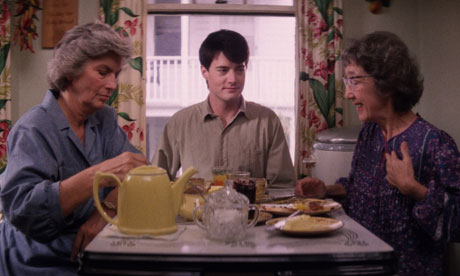
Fig 2: All's well in suburbia
During the first sequence of Blue Velvet, we see a fireman waving at the camera, a policeman helping a group of children cross the street and we hear the lively chirps of birds in the backghround. This scene is almost like a dream of a perfect subhurban environment. We then see what truely lies beneath this tacky, artificial estate: crawling and scurrying insects in the undergrowth. This is the opening which sets the heart of the film on the audience tells us that beneath things that are beautiful, there can can lie things which horror us. Jaime N. Christley mentions on her review: “Cut and dried, Blue Velvet rolls together Lynch's two diametrically opposed, but indivisible, views of American life: One is the "white picket fences" façade, the other its grimy, badly infected underbelly.” Christley and the film explain that the suburbs, a place often depicted as a utopian place where everything is perfect, are not all they seem. Lynch uses this concept to unnerve the audience and to great effect.In comes the main character, called Jeffery, who finds a dead, rotten human ear in the undergrowth. Being the good boy that he is, he takes it to the police station and recalls the events with J.D. Williams, a detective. He requests that he isn't to tell his discovery to anyone.
Fig 3: Sandy and Jeffery
Later on in the film, he meets with a girl from college named Sandy who peaks Jeffery's natural curiosity when she mentions a woman who is significant enough to provoke the police to put her under investigation from afar. Jeffery makes the decision to spy on her. Dorothy, the woman under surveilance, works as a singer for the 'Slow Club', an isolated club near the edge of their town. Fig 4: Dorothy
Much like other films of Blue Velvet's nature, the film depicts the metamorphosis to adulthood via rituals not familiar to us. In the film, the transformation to adulthood is participated in by Dorothy and there are no chains to hold her back.
What makes Blue Velvet unique is its use of lighting, visuals and its constant, shifting atmosphere. The year in which the film is set is apparently nonexistant as it continuously merges different time periods into one, visually stimulating soup, mentioned by Kevin Carr when talking about the visuals of David Lnch “Lynch shows us a bizarre mix of culture, fashion and techniques. The viewer is never 100% aware of when this is happening. It could be the 80s. It could be the 50s.” (Carr, <No Date>) Visually, the film is believable, yet so surreal at the same time. It constantly throws dream-like settings at the audience, yet somehow manages to keep them within the realm of reality. Take the scenes where blood is shown in a close-up view. At the same time we hear the strange audio of the very cells squirming and squishing around. The film is reminiscent of a nightmare.
Fig5: The abusive lover
Blue Velvet's outlook on the word is like as if it were viewed through the eyes and mind of a child and might be intentional since the main character is in his innocent adolescence years. Jaime Russell mentions in his own review that “Jeffrey and Sandy are babes in the woods who stumble into the very adult world of nightclub singer Dorothy (Rossellini) and her torturer-lover Frank (Hopper) - the big bad wolf in this Grimm fairy tale.” (Russell, 2001) He compares them to babies in this big, adult world which is quite accurate indeed. Jeffery doesn't quite know what to make of the display of sexual brutality from Frank against Dorothy as he hides in her closet; his virgin mind cannot cope with it.As if in opposition, the apparency of Sandy's adolescence is much greater. Despite being younger than the main character, Sandy is still in view of the world being either good or evil. The film creates her to be the embodiment of childlike naivety.
Like many types of films like Blue Velvet before it, the film doesn't make it clear what the moral is. Crime and drugs lord over the town, yet authority in the police is apparent, too, but are corrupt through the Detective. Even at the end of the film, the viewers are not given any closure as to whether the crime and corruption are resolved.
BIBLIOGRAPHY:
IMAGERY:
Fig 2: All's Well in Suburbia http://static.guim.co.uk/sys-images/Admin/BkFill/Default_image_group/2011/11/2/1320244920573/blue-velvet-film-still-007.jpg
Fig 5: The Abusive Lover http://www.towatchpile.co.uk/wp-content/uploads/2011/11/Blue-Velvet1.jpg
The Shining (1980)
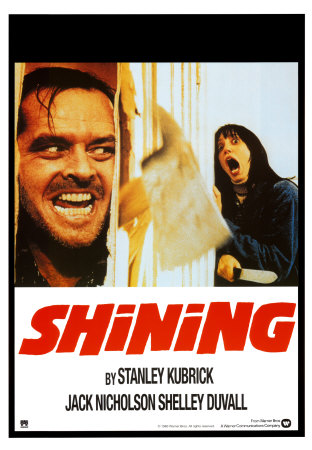
Fig 1. Cover
Daniel Kubrick, known for his precision in film-making and perfectionism, took the making of The Shining to a whole new level. He put his actors through rigorous, numerous scene takes and forced them to do otherwise unpleasent things so that they could act in such a way that would convince the audience. Shelley Duvall, the actress who played Jack's weary and squirrely wife, was forced, by Kubrick, to do over one hundred takes of the same scene. He also made Nicholson eat cheese to give him a feeling of repulsion. This result of this quality of merticulousness has resulted in a brilliantly polished and frightening movie, especially through the use of music and audio, the use of significant images; one such where we see a lift full of blood open and spill into the following corridoor, the image of a beautiful women turning into a rotting, elderly women in the arms of Jack, and finally the all famous depiction of Jack's manical face poking through a splintered hole in a door.
Fig 2. (Corridors)

This film is teeming with various references and each noment of the movie is filled by Kubrick's technique of vague implication of madness through the use of set design and lighting such as the lights in the hotel, the hotel's bathrooms, while clean, give a cold, unatural feeling, and the tall, leering hedges of the hedgemaze. It enhances the idea that, combined with Jack's insanity, being trapped inside of spaces for a while can drive us to cabin fever, which is what Roger Ebert says to us in his review online. “The movie is not about ghosts but about madness and the energies it sets loose in an isolated situation primed to magnify them.” (Ebert, 2006) The constant visuals of distorted perspective add to the theory that the protagonist turned antagonist, Torrance, is going insane. Throughout the film we see Jack talking with spirits (Fig3), but this could also be the film's way of telling us that he is going mad with hallucinations. Again, Ebert explains this in more depth. “Yes, it is possible to understand some of the scenes of hallucination. When Jack thinks he is seeing other people, there is always a mirror present; he may be talking with himself. “ (Ebert, 2006)
Fig 3. (Talking with apparitions)
The hotel itself is built upon a Native American burial ground, which is perhaps where this age-old trope comes from. The hotel is subsiquently haunted by the spirits of the angered dead. This is shown when we see Jack talking to apperitions. As Jack walks into the theatre, it's almost as if he's wandering into the hotel's epicentre of darkness: its heart or maybe even Hell its very self.
Throughout the movie, it isn't fully clarified if its either his own insanity that builds up or whether its the hotel seizing him by the soul. The hotel's former caretaker, Grady, who was driven to insanity and murdered his entire family with an axe, often visits Torrence to try and convince him to do the same thing. The evil of the hotel is suggested to have always had a presence there as suggested by the caretaker's jeer: "You have always been the caretaker."
The question that The Shining seems to be portraying is this: Are all men capable of such evil? Death is not the end for us all, as suggested by the film's final scene of the camera panning into a black and white photograph of the outlook's staff with Torrence in the centre as the caretaker, almost as if he has become a part of the hotel itself. Kubrick has a knack and a fondness for always keeping questions unanswered; to let the audience figure out what comes next. It's something which frustrates us, but Kubrick does it brilliantly.
BIBLIOGRAPHY:
IMAGERY:
Fig 2. (Corridors): http://billsmovieemporium.files.wordpress.com/2011/07/theshininghallway.jpg
Fig 3. (Talking with Apparitions): http://img.tgdaily.com/sites/default/files/stock/article_images/movies/theshining.jpg
Sunday, 8 January 2012
The Uncanny: Final Concept Scene
Used a combination of Photoshop and traditional pencil and paper.
I feel as though the posters really help bring about that 'something's not right here' feeling. :D
Thursday, 5 January 2012
Suspiria (1977)
Fig 1
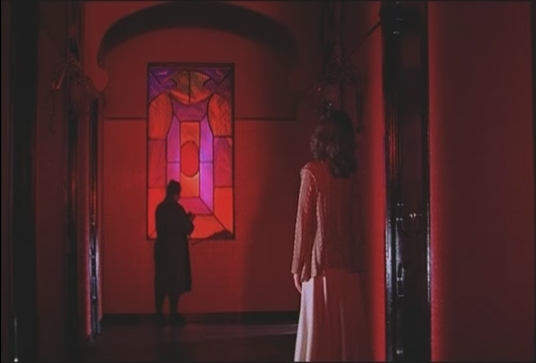
Suspiria is a movie that is supposed to be less about the story and more about the visuals, giving us a feast for our eyes. Suzy, one of the first of many secondary characters introduced throughout the movie, studies ballet in Germany which is where our film takes place. We then see a young woman screaming and fleeing from the school and into the forest beyond.
After meeting up with her friend in her room upstairs, Suzy gazes into a nearby window, suspense building up before an anonymous arm shatters one of the panes, choking the poor girl as the other girl hammers against the door in an attempt to call for help and get inside. The hand impales Suzy again and again before hanging her from the ceiling. Then, as her friend enters the lobby, a rain of glass shards showers down upon her, severing her head into two. This introduction is testament to what is to come: bright sets, dreamy imagery and the redness of blood.
Our main character arrives at the Dance Academy and discovers that the students are disappearing one by one, murdered by a myserious killer that roams the academy. She eventually finds out that a clan of witches is responsible for these acts and torches the place to ashes. This may just be a simple plot, but that is not what the film is about. It is instead a great excuse to throw wonderously created sets and visuals at the audience one after the other. The director, Argento, is a master at suspense and nightmarish scenes that last on the screen for more time than what other film directors consider the maximum. For example, a blind pianist that works for the academy is attacked by his dog and in the following gore sequence, we get morbid close-ups of the chunks of his gizzard being ripped from the poor man's throat. A student tends to her hair in the evening as a wriggling maggot falls into into. She looks up to see masses upon masses of maggots infesting the ceiling. Another sequence is where another student, fleeing for her life from the murderer, tumbles into an abstract pit of barbed wire. There is no camera movement and it sits still, focused souly on the student as she screams and writhes further down into the pit.
Fig 2
Fig 3
Argento's techniques, despite being somewhat abstract, make his gorish scenes much more appearing to look at than it should be within film. He's not the everyday director as 'SM' from the Time Out London Film Guide says in his brief review of the film, stating that “Thunderstorms and extraordinarily grotesque murders pile up as Argento happily abandons plot mechanics to provide a bravura display of his technical skill.” (SM, <No date avaliable>) He states that one doesn't need to follow the default film plot of creating a strict, consistent story that focuses less on art than it does on building the plot. (Fig3) True, such films like Suspiria, if done right, can be more of an artistically influenced experience than a feature film.
Fig 4
The sets created for this film are very artificial and stand out above the realm of reality, using stark, florescent colors to make a surreal, visual and definable film, which seem to be a lot more recognizable than the gore itself.(Fig4)(Fig5), summarized by Anton Bitel of LittleWhiteLies.co.uk, mentioning that “Sure enough, this is a film that entraps the viewer in baroque layerings of noise, colour and texture.”. Bitel mentions that set design can also be more important than the rest of the movie if done right, which is correct for such films as Suspiria, The Labrynth (1986) and even the recent Avatar (2009).
Fig 5
BIBLIOGRAPHY
IMAGERY
Fig 1
Fig 2
Fig 3
Fig 4
Fig 5
(I hate it when I paste the review from a word document and it ends up messing with the text colors and background...)
Wednesday, 4 January 2012
The Wickerman (1976)
(Fig 1)
The British aren't known for creating hit films that win awards, especially horror films. One of the view films that are among the most recognizable, however, is Robin Hardy's 'The Wicker Man'.
(Fig 2)
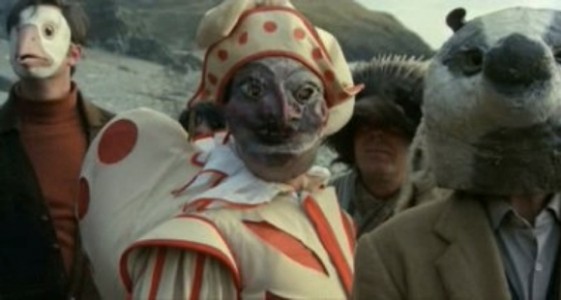
Even from the first scene in the movie, a plane soaring above the seemingly uninhabited Hebrides islands as we listen to the sounds of folk music, it is apparent that this is not your conventional horror movie. It won't take place within the dim light of night time, but will in fact be played out in the grey skies of the British daytime. Sgt, Neil Howie, the apparent protagonist in this film, is a man flying to his death. When he arrives to the isolated island of Summerisle, he is to look for a child that had gone missing. Almost immediately after arrival, he is bombarded with the concept of paganism. Ye' olde medical cures such as a child holding a frog in their mouth to cure a sore throat, nude girls dancing and prancing in the nude over the fire as a fertility ritual and the daughter of the landlord dancing about her bedroom naked. (Fig 2)
The significance of her character is apparent when the film gives us a scene of sexual desire for her by the cop on the other side of the wall as he clings to it for dear life. After meeting the 'ruler' of the isle of Summerisle, a man with the last name of the same name, Howie is mortified that the isle's people seem to have outright rejected Jesus in turn for the worship of Gods of old. The cop then comes to terms with all the clues found: the girl must be the sacrifice and has been hidden away in preparation. However, it is eventually revealed that the sacrifice is not her, but him.
Hardy's famous film throws in all kinds of appealing, yet disturbing aspects of horror; the images of wooden horses, the puppet, Punch and maypoles are familiar to us due to having been part everyone's childhood at some point or another. The uncanny comes into play here as each one of these aspects are distorted in one way or another to turn them into some kind of horrible realization of what was lurking beneath all along. The Wicker Man seems to take inspiration from the works of Heironymus Bosch through the use of surreal imagery.Peter Bradshaw from The Guardian Magazine discusses this by stating: “The breast-feeding woman holding an egg in the ruined churchyard is like a detail from Hieronymus Bosch. And that final sequence, with the eponymous Wicker Man, is inspired.” (Bradshaw, 2007) Quite rightly said, he states that these scenes are almost as if they had been taken directly out of a Hieronymus Bosch painting.
(Fig 3)
The Wicker Man displays strong elements of confliction in religions through the use of Mr. Summerisle and Howie. Both of them are under the impression that they are in the right, yet none of the two are able to see the world view from the other's perspective. The film, however, displays these views to significant depth through its course. Steven D. Greydanus gives more of an insight on this subject, stating: “The double vision persists to the end: The pagans are gay and pleasant and wily; the pagans are degenerate, monstrous, insane. Howie is a fool, a sourpuss, a prude; Howie is an unlikely saint, a prickly victim soul.” (Greydanus, 2006) Greydanus presents us with the aspects of these two sides a little more clearly, stating that the pagans are cheerful and pleasant, but are also savage and mad while stating that Howdie, while an unlikely saint and a victim, he is also prude and sour. In a way, both sides are as bad as each other, but have their respectful aspects.
(Fig 4)
At the end scene of the film, the singing villagers sway from side to side around the burning wicker man in praise to their deities of the earth and sea and Howvie, trapped inside the burning chest of the wicker man shouts to them and preaches the word of God. This is one of the most famous scenes in cinema due to its horrifying nature. The end scene of the wooden figure's burning head breaking away from its body into the sunset gives the audience no comfort, either. (Fig 4)
BIBLIOGRAPHY:
IMAGERY:
Subscribe to:
Posts (Atom)